
Only a person who attends and completes a ten days vipassana meditation course knows what it takes to do it successfully. From getting leave approval in office to getting ticket confirmation to reach vipassana center to getting seat confirmed at vipassana center. Every step is a challenge and one needs to put a lot of effort in order to ensure everything falls in place. We need to keep several things in mind like climate, the tasks planned in office during the course duration, availability of sufficient number of leaves, availability of train or plane tickets according to one’s budget and so on.
This post may contain affiliate links. As an Amazon Associate, I earn a small commission from qualifying purchases at no additional cost to you. Read my disclosure for further information.
A lot goes into deciding what are the things that you are going to pack for vipassana meditation retreat. Shopping for things which you have decided to pack but you don’t currently have for example an alarm clock, torch (and its batteries), portable mirror, air pillow and so on. I have written three articles on this topic and may write even more in future. If you are putting in so much effort in order to attend a ten days vipassana meditation course then you must ensure that you get the maximum benefits from attending this course and this is exactly what I am going to cover in my article.
Right Posture for doing Vipassana Meditation
How many times you have caught yourself falling asleep while doing meditation. Sometimes it could be due to lack of sleep, lack of focus but trust me many times it’s because of wrong posture.
Posture plays a very important role in the quality of mediation. Right posture is a must to ensure that you perform good quality meditation for as long as possible without losing concentration and falling asleep.

Well the right posture is pretty much simple all you need to do is keep your back and neck straight while sitting for meditation. This small change in posture makes a huge difference for Vipassana students. This posture greatly reduces chances of you falling asleep or losing concentration. Even Goenka ji recommends this posture to get the best out of your vipassana session.
When you bend your back forward while sitting for vipassana meditation your neck also leans forward thereby increasing chances of you falling asleep or you losing your concentration. So next time you attend a ten days vipassana meditation course or are doing daily 2 hours meditation practice at home make a conscious effort to keep your back and neck straight.
Make the Most of all Breaks
Morning Break
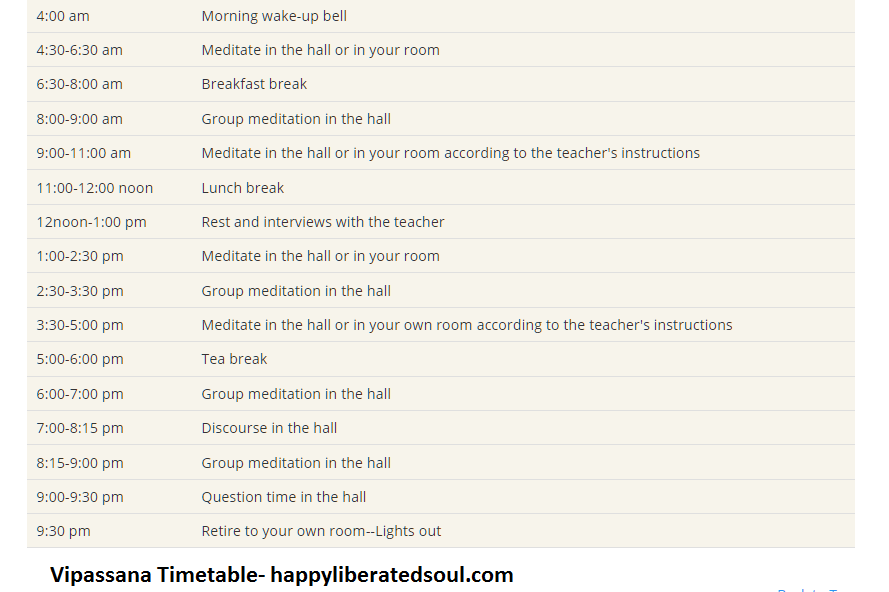
There are 3 major breaks per day during the vipassana meditation course. The first break is from 6:30 am to 8 am in which the first 45 minutes are meant for breakfast so make sure that you eat your breakfast by 7:15 am and complete the rest of the chores before 8 am. Rest of the chores involve your bowel movement, taking a bath and combing basically getting ready for the day.
Afternoon Break
The afternoon break is the longest break of the day and lasts for 2 hours between 11 am to 1 pm. It looks huge on paper but trust me that too passes away quite swiftly if you follow the instructions properly. During this break you are supposed to finish your lunch by 12 noon and the remaining 1 hour till 1 pm is meant for either interview with the teacher, taking rest or both. Interview here means you can clarify your doubts, ask questions regarding the anapana or vipassana meditation technique or discuss any problems you are dealing with at dhamma mediation center.
The reason for calling it an interview is that students can ask the questions privately. In other words when one male student is asking his questions from the assistant teacher other students are generally asked to wait outside the dhamma hall or at the entrance area of dhamma hall when the weather is not suitable to stand outside.
Students get the opportunity to ask questions from the teacher publicly after the last meditation session of the day as well between 9 pm to 9:30 pm. But during this questions session other students who are waiting to ask their questions are also present in the dhamma hall. Although you will get the opportunity to talk with the teacher one on one near teacher’s seat but some other students will also be present in the hall on their allocated cushions.
As per my personal experience, most of the times we get the answers from within while attending a vipassana meditation retreat. This is because students are not supposed to talk to anyone, not use gadgets hence googling is not an option. To add to it, your mind is calm and free from clutter after multiple hours of meditation which is the perfect mental state to arrive at solutions for most of the problems. But still there is no harm in reaching out to the assistant teacher in order to get your queries answered.
Try to make sure that your questions are related to vipassana or anapana meditation technique only and they are to the point because there are other students as well who also want to connect with the teacher and time is limited. Also make sure that you clarify your doubts from the assistant teacher only and not from fellow students, servers or any other person. If you are facing any logistic problem like light not working in your room you may reach out to the server but if you have any doubt pertaining to meditation technique assistant teacher should be your Only go to person.
In case you don’t have any query just take rest for most of this remaining 1 hour. Taking rest is important here, it will give much needed relief to your back, legs and even neck. Remember you are sitting for long hours from 4:30 am to 9 pm (excluding breaks) so some parts of your body definitely need rest and this is the best time for it. There will be a few days when you need to complete your chores like washing clothes, cleaning your room and bathroom, cutting nails, shaving etc. which is fine. But for the other days use this time between 12 noon to 1 pm to take adequate rest.
Trust me in many cases you will get a power nap for as short as 10 minutes or even less minutes and it will be a very interesting experience but don’t get attached to that experience as even that is not permanent. Several students complain that they don’t get proper sleep during the night at dhamma meditation center so such students should make the most of this break to catch up on their lost sleep. Last but not the least as instructed by S N Goena ji every student is supposed to meditate continuously so keep observing your breath and/or sensation on the body during the breaks.
Evening Break
The evening tea break lasts for 1 hour from 5 pm to 6 pm. During this break the new students are served milk or tea with milk, light snacks or fruits and old students are served lemonade, fruit juice or black tea. Once you are done with it which will not take more than 15 minutes you are supposed to walk.
Earlier I used to take rest during this break as well but as on some of the notice boards outside the dhamma hall and near the administration office states “Tea break & Walking” during evening break and I observed that most of the other students take a walk so you must take a walk during this break unless your body demands rest.
In either case don’t forget to be mindful of your breath and sensations on different parts of the body depending on whether you are practicing anapana technique or vipassana on that particular of vipassana meditation retreat.
Eat Moderately
The food at each dhamma meditation center I have visited has been really nice hence as a student you are likely to be tempted to eat more. But trust me the less you eat the better it will be for your meditation practice.
Overeating or meditating with a fuller stomach is likely to make you sleepy during the next few meditation sessions between 1 pm to 3:30 pm. Thus in order to avoid being sleepy eat moderately and keep some part of your stomach empty. For eg. If you have an appetite for four chapatis, eat only three.
Follow all Precepts
Following all precepts (moral conduct) of Vipassana meditation is a non-negotiable prerequisite for practicing vipassana meditation. There are 5 precepts which new students are meant to follow and for old students there are 8 precepts including 3 additional precepts. These precepts are part of code of discipline for Vipassana meditation.

All vipassana students must take a pledge to follow all precepts right at the beginning of vipassana meditation course in the first session. For those who are new to Vipassana meditation here is the list of all precepts both for new as well as old students:
For New Students (those attending their first vipassana meditation course) there are 5 precepts:
- To abstain from killing any being;
- To abstain from stealing;
- To abstain from all sexual activity;
- To abstain from telling lies;
- To abstain from all intoxicants.
For old students (those who have attended at least one 10 days vipassana meditation course) there are 3 additional precepts so total of 8 precepts for them:
- To abstain from eating after midday;
- To abstain from sensual entertainment and bodily decorations;
- To abstain from using high or luxurious beds.
Every student must obey their respective precepts in order to make the most of ten days vipassana meditation course. Assistant teachers may allow some old students to eat after midday due to health reasons. Such a student must inform the assistant teacher that he or she needs to eat food or drink milk or tea with milk in the evening break because of health reasons or pregnancy. The coordinators at the center will provide the food for such students during the evening break.
On paper (while reading) it might feel difficult to follow all these precepts but the environment at the center is ideal to easily follow these precepts without any difficulty. For example every student submits their valuables which includes cash, credit or debit cards, smart watch mobile, camera, laptop before the course begins which are stored securely by the course administrators. In the absence of any valuables there is nothing to steal or worry about your belongings getting stolen.

All the insects and reptiles at the center are harmless and non-aggressive. I have been practicing vipassana meditation for over 11 years. During these 11 years I have attended many vipassana meditation courses at different dhamma centers and I have never seen any aggressive or harmful insect or reptile. They are slow in their movements and in most cases you will not even be afraid when you see them.
I have mentioned this in my other articles as well that at all dhamma centers there is an unstated agreement between vipassana students and insects/reptiles at the center that neither of them will do any harm to the other. Students are obeying this unstated agreement through the precept of “abstaining from killing any being” hence insects/reptiles already know that they are safe from humans at the dhamma center and students will also feel safe after reading this article of mine in case they are not already aware of it.
One must also realize that this awareness will come with time. Even I had realized it during my fourth meditation retreat when I had to deal with the presence of a large number of huge hornets at one of the dhamma centres. Initially it scared the hell out of me seeing the presence of so many big size hornets surrounding my room and the dining area.
At one point during the afternoon break it had become impossible for me to enter my room because there were a large number of hornets surrounding their nests which were present outside almost every student’s room. I was afraid they would probably sting me or enter my room at least, after which it would be almost impossible for me to stay peacefully in my room. I hope reading this you can imagine how big my dilemma was at that moment. I went towards the dhamma hall (where all students perform group meditation) as the path to it was slightly safe. Reaching there I realized it is private interview time so why not share the situation to the teacher and seek a solution from him.
He explained the problem you are dealing with at the moment is fear which is nothing but just another impurity (vikaar) and we just need to observe the sensation that is occurring in our body because of this fear and remind ourselves that it is impermanent and so is the fear. “Hornets are not going to harm you or anyone at the center unless anyone tries to harm them. Not killing any being is one of the precepts which every student is obeying hence it is unlikely that any hornet is going to harm you or anyone. It’s all in your mind” he continued.
Once I told my worried mind to believe in his words regarding hornets and I began to perceive this situation with an open mind, I observed that many students are taking a walk peacefully even on the walking path surrounded by storms of hornets. Then I had to fill the water bottle, when I reached the water cooler I observed that the area was heavily surrounded by thirsty hornets who were also there to drink water. They were touching our hands and fingers while we were filling our water bottles yet there was no hostility or attack from either side.
This was a turning point in my life as I overcame my fear of hornets and any other species at the dhamma center. This is a big lesson for all vipassana students who fear insects and reptiles at the center and I have heard many of them are still dealing with their fears which are disturbing their practice. Hopefully after reading this article they would be able to overcome their fear of insects at vipassana centers and be able to focus on their goal which is performing vipassana while following all precepts.
Speak Up when it’s Necessary:
By now, you must be fully aware that during the Vipassana meditation course, students are not allowed to speak, make eye contact, or communicate through signs or gestures. Now it is up to you to decide in which situation you may make an exception to this rule and speak with someone. There can be situations in which you should speak or at least convey your message to the right person in a timely manner. For example at one of the dhamma centers they were running Air Conditioner in the dhamma centers which is quite common nowadays but its temperature was very low relative to the temperature at the center. To add to it, this was the rainy season.
I was feeling cold and sneezed at least six times inside the dhamma hall. Few other students were also showing signs of cold through sneezing and snuffling. Now my immediate action should have been requesting the server to increase the Air Conditioner’s temperature or switch it off at least for the current group meditation session. But I refrained from making such a request because I am not supposed to speak during the course. As a result I caught a severe cold and fever which impacted my vipassana practice which could have been easily avoided just by speaking up in a timely manner. So the lesson here is speak up when it’s necessary and don’t delay it. But make sure the volume of your voice is very low and you are not disturbing other students.
Submit all your Valuable with the Administrators
As a student you are supposed to submit all your valuables in the administration office. Usually students submit their mobile phone and wallet which is kept safely in a locker by the center administrator or coordinator. If you are carrying some other gadgets like a laptop, apple watch, digital camera, tablet, iPad, kindle etc. you must submit them in the office before the course.
There can be other valuables like jewellery, precious stones etc that you were wearing and you forgot to remove them while leaving for a vipassana meditation course. It is recommended to not wear any jewellery to the vipassana meditation center.
Usually the person who conducts the course introduction session conveys this message to students that if anyone is carrying any eatables kindly submit it in the registration/administration office.
Hence if you are carrying any eatables like biscuits, snacks you are supposed to submit them with the administrator before the course begins. This will relieve your mind of any worry regarding the safety of those gadgets and money in your wallet because it is kept completely safe. Trust me after doing so you will feel as if you got rid of a certain burden from your mind.
By now you must be aware that all kinds of intoxicants including liquor, cigarettes etc. are strictly prohibited to use in all vipassana meditation centers. So it is highly recommended to not carry them to the dhamma center. And if by mistake you happen to carry them then make sure that you communicate this to the center coordinators and submit it in the office before the course begins. Even if due to some reason you were unable to submit it before the course and you realize that you should have submitted them to the office, there is no harm in doing it now. Simply communicate this to the server or the assistant teacher and they will subsequently ask you to do the needful.
Follow Two Hours daily Meditation Practice after the Course
In order to get the most benefits of vipassana you must do two hour daily vipassana practice. A lot of students don’t give importance to this most important aspect of vipassana meditation practice. During the discourse SN Goenka ji clearly instructs that one must practice vipassana meditation after going back for two hours on a daily basis. Usually one hour in the morning and one hour in the evening is the most suitable way to maintain a two hour daily vipassana meditation routine. But you can make adjustments according to your daily schedule.
The goal of vipassana is to not add new impurities in your subconscious mind and keep removing old impurities from your subconscious mind. In order to achieve this goal it is necessary to remove all impurities that get added during the day and this very removal is taken care by practicing vipassana on a daily basis. You can do whatever in your ability to make sure that you are maintaining two hour daily vipassana practice.
If it’s too loud at your home, install a Noise Proof Wedge Panels Structure in your meditation room. Acoustic foam panels triangular grooves structure is perfect for noise absorption, helps to reduce and absorb unwanted outside noise while you meditate peacefully inside the room. It includes with 300 pieces (free) of strong double-side adhesive tape to enable you to finish the installation of the structure without any trouble while protecting the walls of your room from any kind of damage.
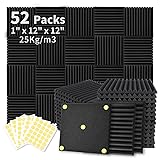
Focusound 52 Pack Acoustic Foam Panels 1″ x 12″ x 12″ Sound Proof Foam Panles Soundproofing Noise Cancelling Wedge Panels with 300PCS Double-Side Adhesive
Pro Tip: If this high-density foam is not in and refuses to return to its original shape, kindly soak it in water for a few minutes and dry in the open space, it will to return to its original shape within 24 to 48 hours.
If you have limited space and you are dealing with internal noise rather than external noise. In other words the noise that is affecting your meditation is coming from within your own room from sources like TV, mobile, a kid, a sewing machine, a music system or a family member than you can use ear plugs to deal with such noise while performing vipassana meditation.
 3M Ear Plugs, 200 Pairs/Box, E-A-R Classic 310-1001, Uncorded, Disposable, Foam, NRR 29, For Drilling, Grinding, Machining, Sawing, Sanding, Welding, 1 Pair/Pillow Pack
If you have problems sitting, buy the best meditation cushion that will enable you to sit comfortably for long duration for practicing vipassana regularly. Florensi Meditation Cushion comes with buckwheat floor pillow designed to alleviate the stress on your joints (especially knees). This sitting pillow for the floor ensure your spine remains straight as you sit in lotus meditation pose. As mentioned above in this article, keeping you spine straight plays an important role in quality of your meditation session and also reduces your chances of falling asleep during meditation session.

Florensi Meditation Cushion – Comfortable Floor Pillow – Traditional Tibetan Meditation Pillow with Beautiful Velvet Cover – Large Floor Cushion Seating for Adults – Premium Yoga Buckwheat Bolster
If your back aches, get the backrest sitting arrangement similar to what is provided by the center. Giantex Floor Chair with Back Support comes with adjustable backrest which can be adjusted at fourteen different positions according to your preference. Meditators with different height and age can gets the flexibility to adjust the backrest which best suits them. Although vipassana is not about seeking comfort but if a little comfort (especially for those who need it) can ensure that you maintain your Vipassana daily routine than nothing like that.
Apart from supporting your back as you sit for your daily Vipassana meditation practice Giantex Floor Chair saves your space when reclined to fully flat position thereby making it easy to store.

malu Extra Large Padded Floor Chair w/Back Support – Japanese Chair Meditation Cushion, Comfortable Folding Backrest, Removable Easy Wash Cover
Remember this investment on your self-improvement is a priceless investment and it is likely to reap wonderful benefits for the rest of your life. In my last three days vipassana meditation course the assistant teacher told me no matter how many courses a student completes at the vipassana meditation center if he is not doing daily two hours practice at home he will never be able to progress on the path to enlightenment through vipassana.
Conclusion
How has been your experience with vipassana meditation practice? What according to you are the ways to make the most of your ten days vipassana meditation course? Do share your opinion on this very important point of discussion. It is always good to hear from fellow vipassana practitioners, more because at the center no one is allowed to talk to each other. It is only on arrival and on the last day that people can talk to each other but most of us are in a rush to catch the next flight, train or bus for that matter. So feel free to share your view in the comment box. Thanks for reading such a long article.
Be Happy
Related Articles
